
The Building Science of a Santa Monica Bathroom: Salt Air, Humidity, Ventilation Math and the Materials That Last
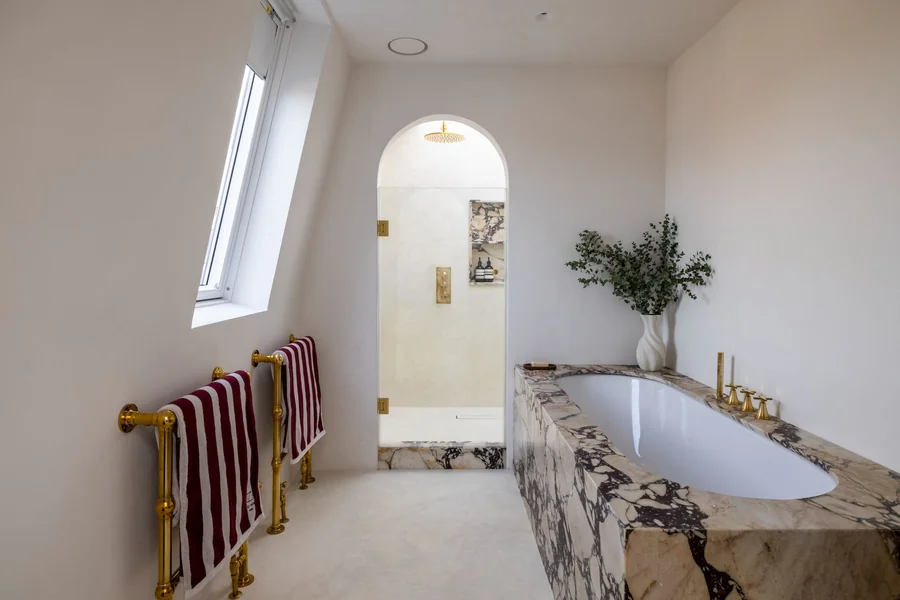
A bathroom three blocks from the beach fails differently from one in the valley. The mirror frame pits. The chrome on the faucet clouds. The paint on the ceiling bubbles in a corner that never seems to dry. The hinges on the vanity doors rust from the inside. None of it is bad workmanship. It is chemistry, and a Santa Monica remodel that ignores it will look tired within a few years no matter how expensive the tile was.
The marine layer keeps relative humidity high for much of the year, the air carries salt, and many of the city’s apartments and older houses were built with minimal ventilation. Understanding those three facts turns a bathroom remodel from a decorating project into an engineering one, which is the only kind that holds up by the ocean.
The moisture budget
Every shower adds a measurable amount of water vapor to a small room. Without enough exhaust, that vapor condenses on the coolest surfaces, which are the exterior wall, the window and the ceiling corners, and it soaks into drywall, grout and wood over and over again. Mold is the visible end of a process that starts with condensation.
California’s energy code requires a bathroom exhaust fan, and in most remodel situations it has to be humidity controlled, meaning it switches on when moisture rises and runs until the room dries. The math is simple: size the fan to the room’s volume, duct it to the outside with the shortest, straightest run possible, and never let it dump into an attic or a soffit. In a coastal apartment, a quiet continuous-ventilation fan at low speed is often the better choice, because it keeps the humidity from ever building up.
Salt air and the metals that survive it
Salt accelerates corrosion, and a bathroom near the beach exposes every metal surface to it twice: from the outside air and from the humid air inside. The finishes that hold up are solid brass fixtures with quality plating, stainless steel of the right grade, and powder-coated or anodized aluminum for frames and hardware. Thin plating over zinc alloy, which is common in budget fixtures, pits and flakes within a few years. Concealed hardware matters too: stainless hinges and drawer slides cost little more and are the difference between a vanity that works in year eight and one that does not.
Surfaces: what to put on the walls and floor
Large-format porcelain tile with minimal grout lines, epoxy or high-performance grout, a proper waterproofing membrane behind the tile rather than just cement board, and a vapor-permeable paint on the ceiling are the combination that performs. Natural stone can work but needs sealing on a schedule and dislikes constant damp. Solid-surface or quartz vanity tops shrug off humidity; wood vanities should be marine-grade plywood or a moisture-resistant engineered product with sealed edges.
A contractor who does bathroom remodeling in Santa Monica regularly will specify these materials by default and explain the waterproofing system before the tile, because the system behind the tile is what determines whether the room stays dry.
The checklist for a coastal bathroom
- Humidity-sensing exhaust fan sized to the room and ducted to the exterior
- Waterproofing membrane on every wet wall and the floor, tested before tile
- Solid brass or stainless fixtures; stainless hinges and slides inside the vanity
- Porcelain tile with high-performance grout and sealed movement joints
- Moisture-resistant drywall or cement board, with vapor-permeable ceiling paint
- A window that opens, if one exists, with a frame that does not corrode
Permits, older buildings and the coastal zone
Santa Monica permits bathroom remodels like any other plumbing and electrical work, and older buildings often reveal galvanized supply lines, cast-iron drains and undersized circuits once the walls are open. Budget for them. Projects near the shoreline can also fall inside the coastal zone, which rarely affects an interior bathroom but is worth confirming before scheduling. Choosing a contractor who will answer these questions before signing matters more than the tile selection, and the questions to ask are laid out in this guide to how to vet a Santa Ana general contractor before you sign anything, which applies to any city on the coast.
Firms with coastal experience, such as Primework Construction, will typically show past bathrooms a few years after completion rather than the week they were finished, which is the only photo that proves the materials were right.
Quick answers
Is a window enough ventilation? No; it helps, but a fan sized to the room is what controls humidity, and the code expects one.
Why does my new faucet already look dull? Salt and humidity attacking thin plating; solid brass with heavy plating or stainless resists it far longer.
Can the waterproofing be checked? Yes, with a flood test of the shower pan before tile, and a good contractor will show you the result.
Primework Construction
730 Arizona Ave Ste 285, Santa Monica, CA 90401
Website: primeworkconstructionca.com/santa-monica