
Locked Out on the Strip – Details That Get You Back In Faster
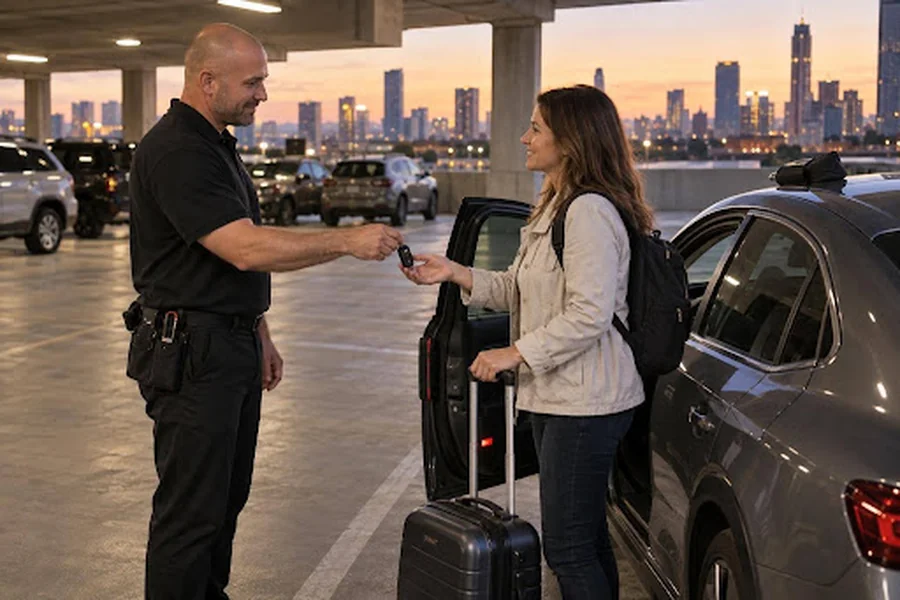
A traveler standing beside a locked rental in an airport garage tells the dispatcher three things: the make of the car, that it is silver, and that they are at the airport. Every one of those is true, and none of them is enough. The airport has several garages and multiple levels, silver is the most common color on the lot, and the make alone does not determine which tool opens the door.
Vehicle entry is now a technical problem more than a mechanical one, and the quality of the information you provide on the phone has a direct effect on how long you stand outside. What follows is essentially the dispatcher’s checklist, written from the customer side.
Pinning down where you actually are
Resort properties on the Strip are not single buildings. They are complexes with multiple towers, separate self park and valet structures, and garage entrances on different streets. A pin dropped in the middle of the property is frequently a hundred feet above or below the car and in the wrong structure entirely.
Give the garage name, the level, the section letter or color, and the number stenciled on the nearest pillar. Then add the nearest elevator bank or stairwell, because that is how a technician on foot with a tool bag will approach you.
Airport garages follow the same logic with an extra wrinkle: terminal, garage, level, row. If you took a shuttle from a rental return, say so, because the car may not be where you think it is. A dispatcher booking a car lockout service in Las Vegas will ask these questions anyway, and having the answers ready removes a full call back from the timeline.
Share your phone’s location pin by text as well, since coordinates settle what descriptions cannot.
Describing the car so the right tools arrive
Year, make, model and trim, in that order. Trim genuinely matters. Two versions of the same model can have different door hardware, and one of them may have no mechanical linkage in the handle at all.
Mention anything unusual about the doors or windows:
- Frameless door glass, common on coupes and many electric vehicles
- Electronic pop out or flush handles with no mechanical release
- Aftermarket window tint, which changes how a seal can be approached
- Whether the engine is running and the doors locked themselves
- Whether the keys are visible on a seat, in the ignition, or possibly in the trunk
That last point changes the job completely. If the keys are visible inside, the work is an opening. If the keys are genuinely missing, the correct service is a key origination, which requires proof of ownership and different equipment on the truck.
Understanding why modern doors changed the method
For decades the answer to a locked car was a thin steel strip slid down inside the door to catch the lock rod. On a car built in this century that approach is close to malpractice. The door cavity now contains side curtain airbag wiring, window regulator motors, wiring looms for mirrors and speakers, and in many cases no accessible rod to catch.
The current method is deliberately gentle. A technician spreads the top of the door frame a few millimeters with an inflatable wedge, protects the paint and the weather seal, then passes a long coated reach tool through the gap to press the interior unlock button or pull the interior handle. Nothing inside the door cavity is touched.
Cars with fully electronic interior releases can defeat that approach, which is why an experienced operator asks about trim before dispatching. On those vehicles the answer is often the mechanical key hidden inside the fob and a key slot concealed under a cap on the driver door handle. Complete Locksmith and other established mobile shops will tell you on the phone which path your vehicle is likely to need.
Expect to show identification and some connection to the vehicle. It is a short conversation and it is the reason the service can be trusted at all.
Knowing when it is not a lockout call
Two situations should not go to a locksmith first.
If a child or a pet is inside the vehicle, call emergency services immediately. Summer surface temperatures in this valley are genuinely dangerous inside a closed car, and the response will be faster and the right people will make the decision. Do not wait on a service quote.
If the vehicle is a rental, contact the rental company before anyone else. Many rental agreements route lockouts through a roadside program, and authorizing outside work yourself can complicate the return. A quick call establishes who is paying and whether a spare key is available at the counter, which is sometimes the faster answer.
Then there is the third case that looks like a lockout and is not. If the doors will not unlock with the fob but you can open them with the physical blade, the problem is the fob or the vehicle’s receiver, not the lock. That is a diagnostic visit rather than an entry.
Finally, plan a spare. A magnetic case under the vehicle is a bad idea, but a second key left with a travel companion or in a hotel room safe costs nothing and removes the scenario entirely.
Quick questions
How long does a typical opening take?
Once a technician is standing at the vehicle, most openings take between five and fifteen minutes, so the travel time through a busy corridor is usually the longer half.
Can a car be opened without damage?
Yes, with proper wedges, protective sleeves and reach tools, which is precisely why the old flat steel strip is no longer used.
Do I need my registration for a lockout?
You need to establish that the car is yours, and a photo ID with a matching registration or rental agreement normally satisfies that.